

You’re probably underestimating what you can contribute
Highlights from my ChinaTalk conversation about Doing Big Things in Policy

I recently joined Jordan Schneider and Kumar Garg on ChinaTalk. I (of course) recommend reading the full post, but wanted to pull out the key message—you’re probably underestimating how much you could contribute and how badly that contribution is needed—and highlight some of my favorite snippets.

You’re probably underestimating how much you could contribute
Kumar described how people want to look for “white space” in policy—areas where no one is working. He says:
Kumar Garg: One of the conversations I have with donors goes like this—somebody might say, “Let’s do a white space analysis. Where’s the white space?” By that they mean there’s some space where everybody’s working, and another place where no one is working. The sad joke is it’s all white space. You get into these problems, and as you dig in, you very quickly figure out there’s a bunch of stuff that’s quite important and not getting worked on.
We discussed a lot of reasons this happens. One is that there are too few people setting goals for themselves and truly making it their job to hit them. (I also recommend the already-classic post by Nan Ranshohoff on why more people should be a “general manager” for a big problem.)
Remco Zwetsloot: They come in saying, “I want to be a public servant. I’m here to do good. Other people might tell me what that is. I expect to come into the office, be assigned a thing, and do it.” Often they come into a space where there’s no clear agenda. You can spend two years in DC just responding to incoming, doing a thing here and a thing there. At the end, maybe you’ve contributed, but you haven’t really changed anything. For that person, you have to push much harder on: what is the thing you want to be different two years from now?
Kumar Garg: You have to be obsessed with winning—with thinking, “This is really important and I really want it to happen.” A lot of times, people in government fall into this idea of “I own this portfolio.” I don’t like the word “portfolio.” A portfolio is a fancy way of saying this is the range of topics whatever seat I’m in has equities in. It’s better to have goals—“I want to move from here to here.”
Another big reason is that, while humility is incredibly important for policy work, it can sometimes paralyze people into thinking they’re not ready to make the jump and won’t be for a long time.
Remco Zwetsloot: There’s a certain type of person, especially folks coming from academia, who think, “I really want to work in policy and public service. I want to contribute, but I need to understand my area just a little bit better before I make the jump. I need to know the full answer to what should happen with China policy before I go and try to get a job where my task is to say what China policy should be.”
My usual response to this is that, from the outside, it can be very hard to know what you need to learn. I explained this using one of my favorite 2x2s (you can take the guy out of the political science PhD but you can’t take the political science PhD out of the guy):
Remco Zwetsloot: On one axis, you have unconscious versus conscious, and on the other, incompetence versus competence. Most people start out unconsciously incompetent. The first part of the learning journey is becoming consciously incompetent. Then you become consciously competent. The journey culminates in being unconsciously competent.
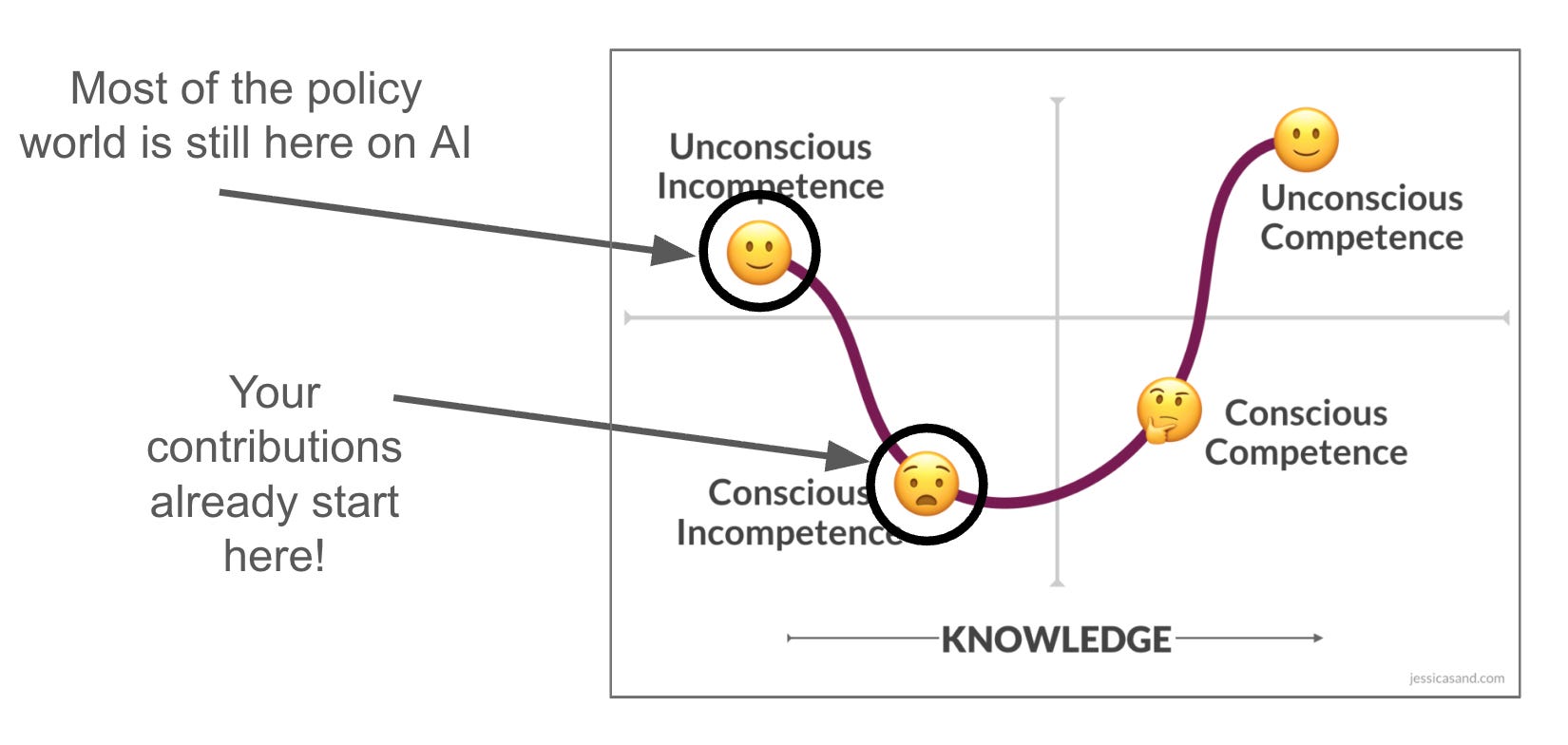
People really neglect the importance of being consciously incompetent. A lot of experts don’t know all the different things they need to know to have the solution for AI policy, for example. It’s just too complicated. If you’re not in DC yet, you don’t know all the ways you need to think about it. But you can know enough about AI to very quickly know what knowledge gaps you need to fill to say something about open-source versus closed-source AI models, or what China is doing in AI.
One of my colleagues, who was a fellow on the Hill, had a nice saying: “Your job is not to be the expert. Your job is to mobilize expertise.” That is your job as a staffer. To do that well, you need to be consciously incompetent—humble enough to know where your gaps are, then entrepreneurial enough to fill them. That’s a really neglected skill set. It lowers the bar for where someone needs to be to make a contribution in DC. Lower your standards. You probably can contribute so much more than you think just by being aware of the gaps and leaning in early.
The need is bigger than you think
The vast white space in policy means a lot of important ideas no one has explored.
Kumar Garg: We still live in a real deficit of clean ideas. I always used to say, when we were sitting around trying to come up with State of the Union ideas, “Why don’t I have a book from each think tank that says, ‘Here’s everything we wrote in the last year, formulated as a State of the Union idea. Here’s the sentence the president would say. Here’s the logic model of the policy proposal. Here’s a link to all the appendices so you can make it bigger or smaller. Here are the phone numbers of the experts you’d call.’” Instead, I’d be hunting around, “Has anyone written on this?”
So more than ever, the world needs ambitious, humble, thoughtful people excited to tackle big problems with concrete ideas.
Kumar Garg: We’re always talent-blocked. We’re bottlenecked on talent on basically everything.
A recent example—in the past five years, there’s been a huge increase in the number of people who realize lead pollution is a really big deal. Maybe a quarter to a third of the global learning gap between rich countries and poor countries can be explained by lead pollution. When I started talking about this five or seven years ago, I’d get a nodding head—“Yeah, pollution’s a problem.”
How many people work on lead remediation globally full-time? Maybe 100. We’re talking about something that might have a trillion-dollar-plus lifetime impact. We underestimate how many really important things don’t have enough talented people working on them.
Horizon exists to build government capacity in emerging tech—one of many efforts trying to close the gaps Kumar describes.
Remco Zwetsloot: If listeners take one thing away from this conversation, I hope it’s Kumar’s earlier message—this is fundamentally talent-constrained work. I could not name you a problem where I don’t think part of the solution is “many, many more people should work on it.” There are complicated “how” questions depending on your personality and personal constraints. But I can guarantee that for someone trying to do good and thinking about science, technology, and China-related topics, there’s so much impact you can have. People in jobs that don’t feel aligned with their ultimate mission in life should think strongly about how to make the pivot in the next couple of years. A lot is changing in the world, and there’s so much need.
Big thanks to Jordan and Kumar for a great conversation—I hope it inspires people to take concrete steps in pursuit of the change they want to see. Some more great resources on breaking into policy and making an impact:
Renaissance Philanthropy’s Policy Entrepreneurship playbook
Jordan Schneider’s Policy Early Career Guide, and ChinaTalk broadly
Thomas Hochman’s learnings from One Year in DC
Our resources on pathways into policy and tips for entering the space on emergingtechpolicy.org
ChinaTalk x Horizon is my type of content
This was refreshing to read! I also feel like this: "They come in saying, “I want to be a public servant. I’m here to do good. Other people might tell me what that is. I expect to come into the office, be assigned a thing, and do it.” The younger generations are even tougher because you usually develop your interests and goals in your early career, and there aren't as many early-career roles anymore. But this issue predates the recent early-career labor market struggles. A lot of people struggle to function autonomously like that.
Maybe young people expect to be released from the arms of the colleges that refused to fail them, into the arms of an employer that is dedicated to their success. They expect other people to tell them how to succeed to show them the path. But few people have been truly impactful through following instructions from someone else, and besides, all the paths look different now! The best thing anyone can do for their career is care - actually care about something, and then dedicate a career to either helping get that thing done, or to doing that thing to the absolute best of their ability.