

How to shape policy from outside government
“The highest-leverage position is being a translator.”

Welcome to Launchpad, a new Substack about working in emerging tech policy from the Horizon Institute for Public Service.
The best ideas on working in emerging tech policy tend to travel through closed networks. After four years spent helping emerging tech experts enter and excel in public service, we’re starting Launchpad to share more of these ideas with you—whether you’re considering a move into the field, already deep in it, or tracking it from afar.
You can expect Q&As with people shaping emerging tech policy, analyses of the field, and practical career guidance drawn from our conversations with hundreds of hiring managers, policy leaders, and people looking to break in.
We’re publishing 3 posts this week to celebrate Launchpad’s launch—this is the first. Subscribe to get new posts in your inbox:
If you’re considering a think tank job or weighing which ones are worth joining (or even if you already work in one), this post is for you. Horizon’s Remco Zwetsloot sat down with Todd Moss, founder and executive director of the Energy for Growth Hub, because Todd’s written some of the clearest thinking we’ve seen on how think tanks actually have a positive impact (much of it on his Substack, Eat More Electrons). We wanted to pull out the takeaways most useful for people evaluating whether think tank work is right for them—but Todd also shares valuable insights for anyone trying to understand how policy ideas actually get adopted.
Todd runs the Energy for Growth Hub, a nonprofit dedicated to ending global energy poverty. He’s a former Deputy Assistant Secretary of State for African Affairs and previously served as chief operating officer at the Center for Global Development, where he helped create the blueprint for what would become the U.S. Development Finance Corporation. On the side, he writes international political thrillers.
We cover:
How to tell which think tanks actually have impact
Why being a translator is often higher-leverage than being an expert
The “poker game” of getting things done in government
Who and what Moss bets on when hiring
Remco Zwetsloot: What do you think makes some think tanks more impactful than others?
Todd Moss: All humans respond to the incentives they face. For a lot of people, especially early in their careers, you’re responding to prestige signals from your peers and from the people you admire. If those people are signaling that hosting an armchair chat with a retired Secretary of State is the pinnacle of influence, then that’s what you try to do. If getting a publication in a particular magazine or journal is the thing, then that’s what you aspire to.
But some think tanks actually don’t aim for that. They’re aiming for real, measurable impact in the world, and the incentives inside those institutions encourage experimentation, failure, and really just trying to get things done.
You can pick this up in how think tanks explain their purpose. Some have trophy buildings, annual galas with people in tuxedos, and a stream of household names coming to speak. Others have none of that. They don’t do events. You might not have even heard of them. But they have a record of accomplishments—they’re placing people into government positions, their ideas are getting adopted by governments, and they can point to what they’ve actually achieved in the real world. How think tanks talk about themselves is a tell.
Going a little deeper here, you’ve said that people conflate outputs, impacts, and results all the time. What do you mean by that?
Todd Moss: If people are talking about their impact in the world and their answer is “a 75-page report was published,” they’re not connecting what they’re doing to a specific purpose. Maybe a 75-page report is exactly what the world needed. If you’re working on tweaking the regulations for nuclear safety, maybe a very detailed report could have high impact. But it’s not the report that matters—it’s who is using that report and toward what end. People often get those things conflated.
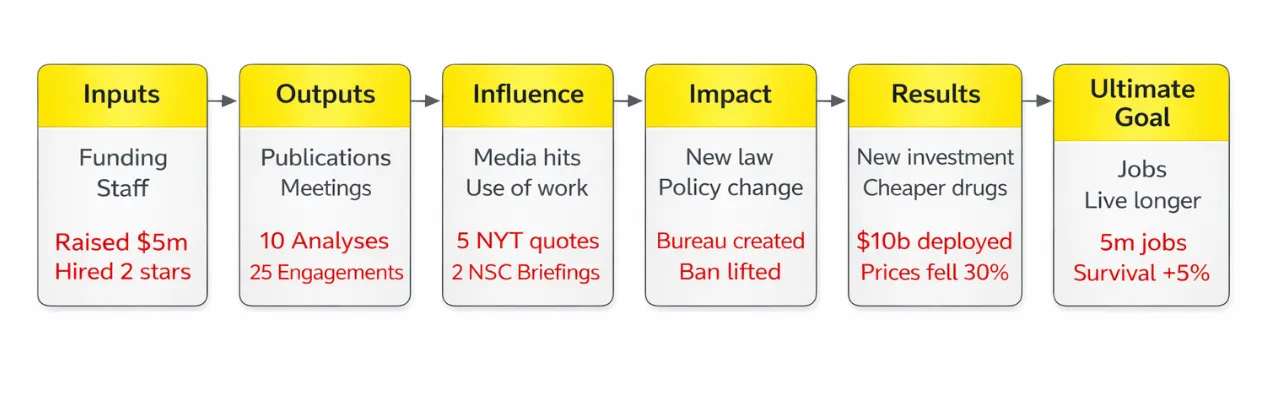
Moss’s 6-step model for tracking think tank impact, from “What Is Think Tank Impact? (And What Is It Not?)“
Horizon advises a lot of people who are thinking about whether policy is right for them and what jobs they should pursue. If you’re someone trying to decide whether to work at a think tank, how do you assess their work from the outside? An op-ed could be there just because someone wanted to write one, or it could be part of a strategic campaign—and it’s hard to tell which is which.
Todd Moss: If you get to an interview and the person interviewing you has an op-ed in the New York Times, I would ask them straight up: “I read your terrific op-ed. What were you trying to achieve with it?” And then listen. Most people have enough self-awareness and humility to tell you the truth. They’ll say, “Yeah, it got in for some random reason and it didn’t lead to any effect.” Or they’ll say, “Because it was in the Times, I got called by the staff of this senator and it actually wound up impacting this legislation,” or “So-and-so from Treasury called and they actually changed something.”
You will find a lot of very self-reflective people who have—even if they don’t articulate it well—a game plan. There’s a purpose to what they’re doing.
And then there are a lot of people who really think the op-ed is the end in itself, not a means to another end. They think it’ll impress their parents or their grandmother. My grandmother used to call me when I’d get in the newspaper, and that’s a fine feeling, but you’ve got to separate that personal satisfaction from actual policy effect.
For an employer to be honest and open about their purpose—and to be reflective not only on what went well but on what hasn’t worked—that’s what you’re looking for. I’ve spent almost my entire career trying to influence U.S. government policy from the outside, and the failure rate is huge. It’s much more like venture capital than index investing. You want somebody who’s reflective on that.
There’s a saying in DC: those who know don’t talk, and those who talk don’t know. How much think tank impact actually becomes public, versus staying private?
Todd Moss: For some think tanks, everything they do is public—that’s their model. But for the ones having a big effect, the majority of their work is actually done quietly.
At my organization, we put out a good amount of public content, and it helps us build our network, which is the purpose. But almost all of our high policy impact work is quiet. The majority of my policy work consists of one- and two-page memos written for a particular individual, never made public, and often tailored specifically to that single person to get them to do a particular thing.
Doing it in public would actually undermine what we’re trying to do. While we occasionally talk about our impact for fundraising and institutional growth, we actually want the policy changes to be owned by the policymakers.
So being discreet is part of being effective. At the same time, I still think it’s very important for institutions to be able to explain what they do. You can be even more candid with your board and funders. Sometimes there’s a zero-sum tradeoff between being well known and being effective. If you burn a relationship by being too public, you will have lost that channel permanently. I make tons of mistakes—I keep things private that don’t need to be, and I’ve revealed things that probably would have been better kept quiet. You have to make a judgment call on the costs and benefits.
Another question we often get is about how the impact of even well-targeted think tank work can feel uncertain relative to working inside government. You have to wait for a policy window, but you’re not sure if or when it will appear. When you work on a project, what signals do you look for to know whether to persist or pivot?
Todd Moss: The biggest signal is that I’m gaining traction with people on the inside. If you find something that is bugging people inside government—something they can’t solve and can’t even talk about—and you can give voice to that problem and start problem-solving from the outside, that’s how you gain credibility.
If you find something that is bugging people inside government — something they can’t solve and can’t even talk about — and you can give voice to that problem and start problem-solving from the outside, that’s how you gain credibility.
One of the things I often do is, long before we go public with an idea, we pressure-test it with people. “We know you’re trying to deal with this problem. Here’s an idea we’re playing with. What do you think?” Usually the first answer is, “That’ll never work because of A and B.” You say okay, come back, and say, “For A, we think we can deal with it this way. For B, we think we can overcome it like this.” As you start iterating, they often go from a skeptic to someone curious to an ally.
Ben Leo and I—my partner in crime in helping create the blueprint for the DFC—went to pitch it first to Senator Corker from Tennessee, a Republican who chaired the Senate Foreign Relations Committee. Literally in the first meeting, he stood up and said, “This is a terrible idea,” and told us why. We came back and said, “This is why you’re worried, but it actually isn’t a problem for these reasons.” We went back and forth, and by the third conversation, his staffer was coming to us with new ideas to make the proposal better.
The idea changed quite a bit through that process, and we had to be open to shifting. But that iterative process—which had to happen behind closed doors—is what allowed the idea to grow, evolve, and become feasible. You can think big thoughts on the outside, which is a freedom staffers don’t have on the inside. But you can also come up with wacky ideas that can’t possibly happen because you haven’t thought of everything. People on the inside are in a much better position to judge political and practical feasibility—they just don’t have the time or space to think big. So you have to build long-standing trusted relationships. Trust is what matters most.
And you can also play a connector role across a siloed government.
Todd Moss: Exactly. It sounds a little like horse trading, but outsiders will hear of things going on across different agencies long before insiders might. You can drop crumbs—”Hey, just a heads up, this is what I heard”—and you’ve built an ally. They’ll come back to you with other information and ideas. I have people I knew as congressional interns who are now in super influential positions, and we’d been joking and sharing tidbits for ten years. It’s playing the long networking game.
When you were newer to policy, what were the formative learning experiences that shaped how you work?
Todd Moss: I’ve got a lot of formative stories, but two really stick with me.
The first is about how to communicate with government people. When I was at the Center for Global Development, the standard tool was a cross-country growth regression—papers with regression tables and statistical analysis. Then I went into government, and not once, ever, did I see a regression table. Instead, what I had was a steady stream of extremely short summaries—usually one page or less—telling me the bare minimum I needed to know, what was credible, and how to make decisions from that information. You’re just overwhelmed.
When I went back to the think tank world, I literally stopped doing cross-country regressions. The real value isn’t always producing unique research—it’s that there’s so much amazing analysis in the world that sits on a shelf, completely inaccessible to policymakers because nobody is translating it into the words and format they can absorb.
So the highest-leverage position is being a translator between the analyst-expert community and the government community, rather than being one of many dozens of experts producing long reports.
Todd Moss: One hundred percent. But it’s also about problem identification. In academia, the upstream decision-making about what to research is driven entirely by publications and methodological questions. But in government, they have a couple of top-line burning questions. If you’re not answering a question that’s already top of mind, your work is irrelevant. So it’s the translating and the problem identification—those are the two very high-leverage points.
The second formative story: On my first day as a State Department official, my boss, Assistant Secretary Jendayi Frazer—a hard-charging, elbow-throwing policymaker who was very effective—grabbed my forearm and said, “I want you to remember: the enemy is right here in the building.” I didn’t know what she was talking about.
What I learned is that the art of policymaking is not convincing some foreign leader to be nicer to the United States. It’s getting different parts of the U.S. government and different parts of the State Department all on the same page. There’s a whole poker game going on—people using influence to stop or advance certain policies—and it takes a while to figure that game out. That’s what she was telling me.
On my first day as a State Department official, my boss—a hard-charging, elbow-throwing policymaker who was very effective—grabbed my forearm and said, “I want you to remember: the enemy is right here in the building.” I didn’t know what she was talking about. What I learned is that the art of policymaking is not convincing some foreign leader to be nicer to the United States. It’s getting different parts of the U.S. government and different parts of State all on the same page.
So for someone new to the field, the takeaway is to do work that isn’t just writing reports—do the one-to-two-page memo format, be in rooms where you have to tailor your output to particular decision-makers, and learn the interagency dynamics.
Todd Moss: Yes. And take the networking component seriously as a skill. It’s not a nice-to-have—it’s the channel for actually getting things accomplished. If you’re walking into a meeting and you want to get something done, and you don’t already know what everybody thinks about it, you’ve already lost. Everyone else has pregamed what they’re going to do and where they are. If there’s negotiating to be had, it should have already happened.
If you’re a scientist thrown into some interagency meeting and there are 25 people in the room and you’ve never seen 20 of those faces before, you’re completely lost. Get to know your peers in different parts of your building and the other buildings that matter in your space. Get to know what they care about, what they object to, what motivates them, what their boss is telling them to do. That will make you much more effective.
Never waste a meal or a happy hour. Every lunch is an opportunity to sit down with somebody, break bread, learn about them and their background. You’ll start to learn the culture. That’s where you’re going to network far more effectively than two people across a desk in suits.
You’ve written about Nancy Birdsall betting on young rising talent and giving them freedom to run, and you’ve said you follow the same recipe at the Hub. What do you actually look for when hiring, especially in people without traditional policy backgrounds?
Todd Moss: I look for people who are genuinely curious and self-aware and self-reflective. Think tanks have a lot of freedom, so you need people who are genuinely motivated by the mission and willing to try things and learn. People who are in think tanks to pontificate about their expertise are not that interesting. People who want to learn and problem-solve in groups—that is where you get a lot done.
You certainly want somebody who’s trying to learn the policy process. I often ask people, “What’s your dream job in ten years?” The best answers are an ambitious stretch of a government job, but something that’s doable. One of the great things about the United States is you can be in your twenties and get in a really influential position. That is not true in almost all other governments. I was a deputy assistant secretary at 37, and I was 30 years younger than almost all of my African counterparts.
One of the great things about the United States is you can be in your twenties and get in a really influential position. That is not true in almost all other governments.
How can a candidate tactically signal these qualities to a hiring manager?
Todd Moss: People do really well when they’re comfortable with the content but aware that they’re not experts yet. They signal that they’re a sponge and they just want to learn and work hard. DC is full of really smart, young, ambitious people working incredibly hard, and the best candidates want to be part of that next generation making U.S. policy better. I definitely want people who show humility. If you lack humility early on, it creates all kinds of problems.
One thing I’ve started doing: I’ve found that U.S. universities are doing a terrible job of surfacing underappreciated talent. So we’ve started asking applicants to answer three questions, and we read the answers blind to their name and CV. It helps us get away from affinity bias. Part of me would love to hire a Tufts grad—I went to Tufts—but overindexing on that makes my recruiting decisions worse, not better. Some of the best people I’ve ever hired did not come from top schools. They were just really hard workers who stood out in other ways. I try to discount the big name-brand schools and put more weight on grit, creativity, and passion.
A notable absence from your list is deep subject-matter expertise. We see AI experts come to Horizon who are curious about policy but feel like they should stay in the sector longer because they “don’t have all the answers yet” on what they think U.S. AI policy should be. How much should that actually give them pause, versus just jumping in?
Todd Moss: I think there’s a baseline you need of comfort and experience with the basics of the field, and you need some experience with how things have happened in the past. But if you come in thinking you’re the world’s expert on something, the chances that you’ll be effective at changing policy are actually quite low. You won’t have the surrounding context. Policy influence is not about coming up with the ideal solution—it’s trying to make the best of a complete mess. Nothing is working ideally. It’s a chaotic dumpster fire, and you’re trying to get the best outcome you can. The world’s leading expert won’t see that as success, but that is what you’re going for.
The other thing is that you can always buy in expertise. I work a lot on nuclear power. I know nothing about nuclear engineering—nothing. But I have a whole network of people who can tell me what it takes to turn nuclear fuel into a weapon. Those people, though, are not going to be good at designing a policy regime to prevent countries from doing that. They don’t have the policy and political context, or an understanding of how the bureaucracy works.
So it’s knowing what you know and finding out what you don’t know. That speaks again to the networking effect—outsource as much as possible and focus on your core mission: getting to the best outcome you can.
Any final piece of advice or inspiration for someone who’s excited to have policy impact but doesn’t know where to begin?
Todd Moss: Public service can be frustrating, but it’s so rewarding to see your efforts become a reality in government, because the scale is so much greater than anything else you could do. It’s why I work on energy policy instead of running power lines or installing solar panels. I don’t want to just do a few things—I want to try to impact entire sectors and entire countries’ trajectories. That’s what public policy allows you to do.
Public service can be frustrating, but it’s so rewarding to see your efforts become a reality in government, because the scale is so much greater than anything else you could do. It’s why I work on energy policy instead of running power lines or installing solar panels. I want to try to impact entire sectors and entire countries’ trajectories. That’s what public policy allows you to do.
Big thanks to Todd for taking the time. If you enjoyed this conversation and want to learn more:
Todd’s Substack: Eat More Electrons
Horizon’s guide to think tank work on emergingtechpolicy.org
CGD: How Might Think Tanks Make Real Things Happen? Lessons from the Creation of the DFC
How to Reverse a Coup, Todd Moss on Statecraft
Policy Entrepreneurship, Renaissance Philanthropy
Launchpad is a resource from the Horizon Institute for Public Service, a nonprofit, nonpartisan organization working to address the U.S. government’s critical talent shortage in emerging technologies. Learn more about us and our programs supporting tech policy careers here, and explore our in-depth policy career resources at emergingtechpolicy.org.
It's funny how I'm nodding along throughout the whole article, but then realize I just wrote an article arguing something different - the necessity of an outside game. I hope it's okay to share even though it's not about emerging technology, but the problem I'm trying to address is a lack of basic research into my disease (ME/Long Covid).
I'm curious if you or Todd think I'm wrong, or if some categories of issues require an outside game in addition to the inside one. Or can a strong enough inside game achieve basically anything?
Citing from my post:
> Last week, German patients with Infection- Associated Chronic Illnesses (IACI, such as ME/ CFS and Long Covid), held protests nation-wide. The protests were very well-attended, were successful in generating a lot of media attention, and were crucial in generating one of the biggest ME/CFS victories ever: a €50 million/year research program for IACIs. [..]
> I believe protests are very important to achieve our goals, because I subscribe to a view I call power realism: by and large, change happens because the coalition pushing for change has enough power to overcome opposing forces and institutional inertia. This was necessary for AIDS and it’s necessary for IACIs. Politicians try to win votes by serving powerful coalitions and cultivating positive media attention. Bureaucrats try to further their careers in a similar way. Funding needs to come at the cost of something, which means opposition that needs to be overcome.
> An inside game - cultivating relationships with policymakers, sharing knowledge, making arguments - cannot achieve much without a strong outside game. The IACI community has definitely tried an outside game, and I have an enormous respect for every organizer and participant that has fought for the cause. But they have faced large obstacles, have had little support, and haven’t achieved the necessary sustained pressure.